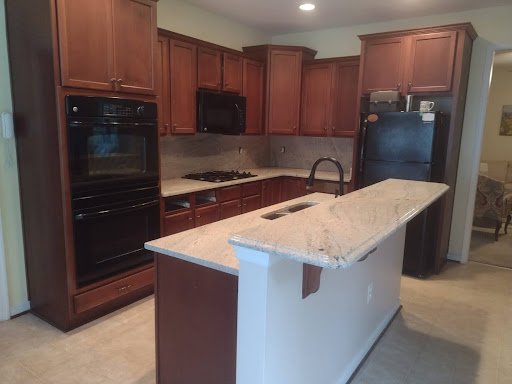
Yes, in most kitchens you can install granite countertops over your existing cabinets without tearing anything out. This is the standard approach for the vast majority of countertop replacement jobs, and it’s one of the reasons granite remains a popular upgrade for homeowners across Virginia who want a real stone look without a full kitchen remodel. That said, “usually fine” isn’t the same as “always fine,” and there are a handful of situations where your cabinets need attention first.
We’ve installed custom granite countertops in kitchens from Richmond to Northern Virginia to Virginia Beach, and cabinet condition is the first thing our team checks on every estimate — before we even talk about color or edge profiles. Here’s what actually determines whether your cabinets are ready for granite, and what to do if they’re not.
Why Cabinets Matter More Than People Expect
Granite is heavy. A typical 1.25-inch slab runs somewhere between 18 and 20 pounds per square foot, and a mid-size kitchen might carry 800 to 1,200 pounds of stone once everything is templated and set. That weight needs to sit on a stable, level base. Cabinets don’t have to be new or expensive to handle this — they just need to be structurally sound and roughly level.
Most cabinets built in the last 30-40 years, whether stock or custom, are engineered to support stone. The cabinet boxes, not the countertop itself, bear the load, so the question isn’t really “is granite too heavy for my kitchen” — it’s “are my cabinet boxes still doing their job.”
What We Check Before Saying Yes
When our installers come out for a template appointment, they’re looking at a few specific things:
Structural integrity. Are the cabinet sides, back panels, and corner blocks intact? Water damage under sinks is the most common issue we find in older Virginia homes, especially in coastal areas like Virginia Beach where humidity takes a toll faster.
Level and plumb. Cabinets don’t need to be perfectly level — a good fabricator can shim and adjust during install to correct minor variance. But if a run of cabinets is off by more than about a half-inch across its length, that’s usually a sign of a bigger settling issue worth addressing first.
Attachment to the wall. Cabinets should be securely screwed into wall studs, not just resting against drywall. This matters more for upper support in peninsula and island setups, where overhangs put extra stress on the front edge.
Support for overhangs. Any granite overhang beyond 6 inches — like a breakfast bar or island edge — typically needs corbels, brackets, or a plywood support layer underneath. This is a common oversight when people assume “over the existing cabinets” means zero extra work.
If your cabinets pass these checks, installation is straightforward: templating, fabrication, then a one-day set where the old countertop comes off and the new slab goes on, usually with minimal disruption to the rest of the kitchen.
When Cabinets Need Work First
Sometimes the answer is “yes, but.” A few scenarios where we recommend addressing the cabinets before granite goes in:
- Water-damaged particleboard, common under sinks and dishwashers, needs to be replaced or reinforced. Stone on a soft base will eventually shift or crack.
- Cabinets that are visibly racked or out of square, often from age or a house settling, need shimming or bracing.
- Older builder-grade cabinets with thin, unsupported tops sometimes need a layer of 3/4-inch plywood added before the stone template, giving the slab a solid, even surface to rest on.
None of these are dealbreakers for granite — they’re just line items that get handled during the same project, usually adding a day or two to the timeline rather than requiring a cabinet replacement.
A Note on Laminate and Older Cabinet Runs
We get this question a lot from homeowners with 1980s and 90s-era kitchens: older laminate cabinets can absolutely support granite, as long as the boxes themselves are solid wood or good-quality plywood underneath the laminate skin. The finish on top is cosmetic and doesn’t affect load-bearing capacity. If anything, swapping in a granite countertop is one of the highest-impact updates you can make to an outdated kitchen without touching the cabinetry at all — it changes the whole feel of the room for a fraction of a full renovation cost.
What This Means for Your Project
If you’re weighing custom granite countertops for a kitchen update, the cabinet question is worth answering early, not after you’ve picked your slab. A short in-home evaluation tells you exactly where you stand, and in the majority of cases, existing cabinets in Virginia homes are perfectly capable of supporting a new granite top with no structural changes at all.
Frequently Asked Questions
1. Do I need to remove my old countertop before installing granite?
Yes. The old countertop material — laminate, tile, or an older stone surface — has to come off so the granite fabricator can template directly against the cabinet tops. This is a quick step, usually done the same day as the granite installation.
2. How much weight can typical kitchen cabinets support?
Well-built cabinet boxes, whether stock or custom, are generally rated to hold several hundred pounds distributed across their tops — more than enough for a standard granite installation. The concern isn’t total weight so much as even weight distribution and solid attachment points, which is why a pre-install check matters more than the cabinet’s price point.
3. Can I install granite over IKEA or other budget cabinets?
In many cases, yes, though it depends on the specific line and how it was assembled. Some budget cabinet systems use thinner particleboard that benefits from a plywood support layer before the stone goes in. Our installers flag this during the template visit so there are no surprises on install day.
4. Will my cabinets need to be perfectly level for granite to look right?
No. Minor unevenness is normal in real homes and gets corrected with shims during installation. What matters is catching larger structural issues — like a sagging corner or water-damaged base — before fabrication, since those need repair work rather than shimming.
5. How long does it take to go from old countertop to new granite?
For a straightforward job with cabinets in good shape, expect roughly 1-3 weeks from template to install, which is standard across most granite countertops in Virginia projects — template appointment, slab fabrication (7-14 days typically), then a single-day installation. Jobs requiring cabinet reinforcement add a few extra days for that repair work before fabrication can start.